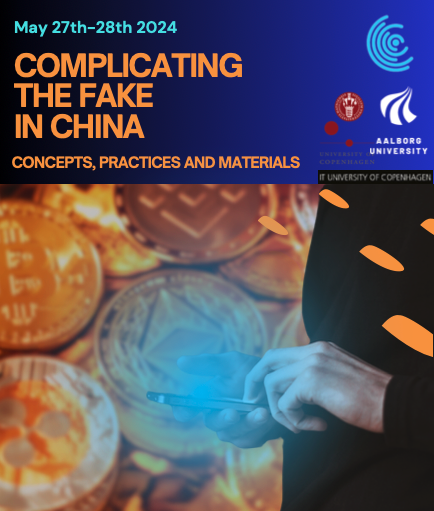
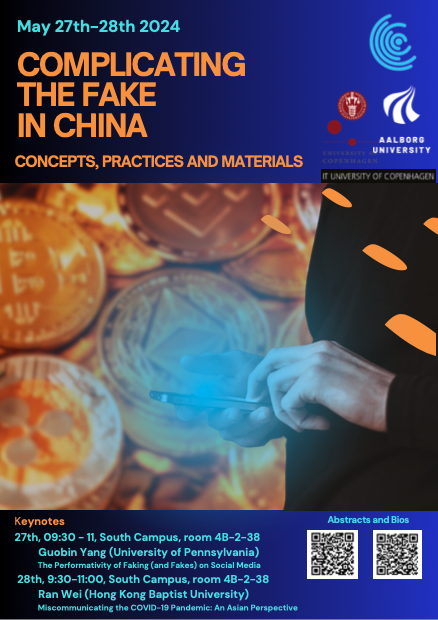
Next month, we will co-host with colleagues in the CATCH network an international symposium called Complicating the Fake.
This interdisciplinary symposium brings together scholars interested in fakes and faking in China. The symposium takes an interest in questions that arise in the course of the everyday life of faking. We will explore the making of fakes, their reception, and mechanisms to manage them, from a range of disciplinary perspectives. By hosting a cross disciplinary conversation, we aim to extend our understanding of what gives rise to fakes, how they circulate, how they are assessed, their impacts, and the people who work with them. such as the degree to which fakery is obvious or hidden, or how fakes are governed and managed.
As such, we invite draft papers that pay attention to one or more of the following areas: the character of faking as a practice, perceiving and identifying fakes, faking as embedded in systems (institutional, social, technical), the creativity of the fake, the fake’s opposites, the consequences of fakes, as well as faking in the digital era and/or responses to it. Conceptually, we invite work that explores the relation of the fake to proximate concepts, with the ambition of differentiating and complicating the category of the fake both across disciplinary conversations and as a contested analytic lens through which to understand tensions and transformations in contemporary Chinese society.
We invite scholars in fields such as sociology, anthropology, STS, communication studies, empirical legal scholarship, political science, geography, philosophy and similarly aligned fields to join us to help explore the question of how we can complicate notions of the fake and fakery in Chinese settings.
Event Format
The format requires pre-circulated papers with assigned discussants. Participants should be prepared to share their draft work in advance. Those interested should send
- Proposed paper title, along with a 250-300 word abstract indicating research question and objectives, approach and methodology, findings and future directions, along with 5 keywords.
- a cover page with full name, affiliation, email address of presenter, and bio.
The workshop is funded by the DFF CATCH Network and DFF Moving Data Moving People project. There is no conference fee to attend. Lunch and dinner will be provided.
Leave a Reply