
ECREA 2026 – inspiring, highlevel, motivating conference
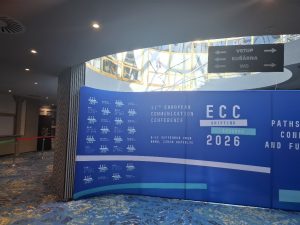
The final conference of 2026, for me, was ECREA 2026: Shifting grounds, paths, connections, and futures, held in Brno, Czech Republic, from 8-11 September 2026. ECREA, the European Communication Research and Education Association, brought together European /international scholars from across the diverse fields of communication and media studies for its 11th conference, offering three and a half intensive days of presentations, discussions, networking, and social engagement. You can read more about ECREA’s objectives here.
I have attended every ECREA conference since the second edition of this biennial event, which took place in Hamburg in 2010. Over the years, I have therefore had the opportunity to follow the association’s development and growth, not only in terms of size but, more interestingly, in the ways it reflects the interplay between societal change and emerging research agendas related to digitalisation and other pressing issues. Throughout the lifetime of the organisation and the conference, we have witnessed waves of innovative and critical research focusing on mobile technologies and mobile media use, networked society, social media, and, more recently, the promises and challenges associated with AI. In many ways, it is remarkable to reflect on these developments in both societal and scholarly contexts. At the same time, it is thought-provoking to recognise how often we must revisit and rethink enduring historical continuities and persistent human and technological conditions if research is to contribute to new understandings and evidence-based (policy) action.
My own presentation, delivered in the Political Communication section, was titled “Talking 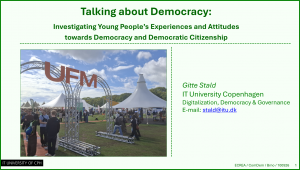 about Democracy: Investigating Young People’s Experiences and Attitudes towards Democracy and Democratic Citizenship.” As always, the title was rather long, but when you only have fifteen minutes to present, you need to make the most of both your slides and your abstract!
For the first time in many years, I chose to focus primarily on methodological approaches in my presentation. Increasingly, I have become aware of the extent to which the quality of empirical research depends on our ability as researchers to look beyond surface-level responses, while, of course, remaining careful not to construct data ourselves. In relation to my current research, this means finding ways to encourage young participants to move beyond their immediate reactions to questions and prompts. Initial responses often reflect learned or socially rehearsed reflections, whereas eliciting more complex, personal, and experience-based perspectives requires specific methodological strategies. This applies both to interview techniques used in individual and group interviews and to the combination of complementary methods that can stimulate an ongoing process of reflection. In my most recent data collection, I began with in-depth interviews with twenty upper secondary school students aged 16-19. Insights from these interviews informed the next two stages of the study, which involved three upper secondary school classes comprising a total of seventy-five students.
In the first stage, students were asked to write a compulsory essay on either digital citizenship among young people or youth democratic participation. In the second stage, we conducted a workshop that combined short evidence-based presentations with small-group discussions around a series of questions. To conclude the workshop, each group was asked to produce either a rap track or a podcast designed to motivate slightly younger adolescents to engage in democratic participation.
Over the years, I have collected an enormous amount of empirical material and have continually experimented with different research formats. However, I must say that the material from this most recent study, which I am still in the process of analysing, is exceptionally rich, informative, and inspiring. Judging from the reactions during the conference panel session, the audience found the methodological approach inspiring as well. The presentation generated many thoughtful and engaged questions. As a researcher, it is always both a relief and a pleasure to encounter genuine interest alongside constructive criticism.